
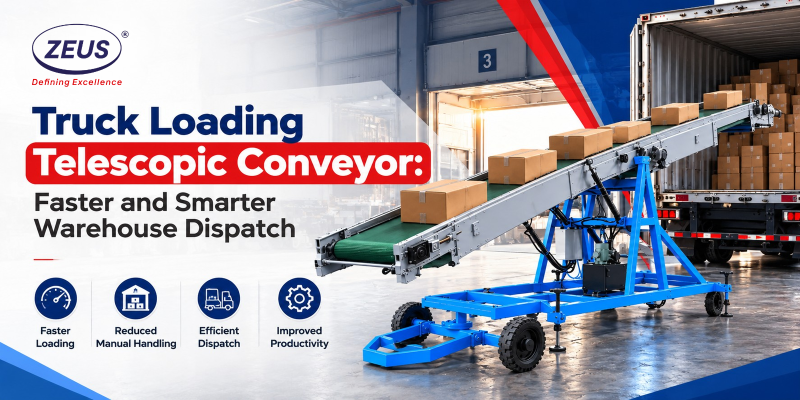
Every minute matters in warehouse dispatch. As shipment volumes increase, businesses need efficient ways to move packed goods from warehouse floors into trucks and containers. However, manual loading can create delays, require repeated movement and make it difficult to maintain a consistent dispatch flow.
A Truck Loading Telescopic Conveyor offers a practical solution by extending the conveyor belt toward the vehicle, bringing the material transfer point closer to the loading area. This arrangement helps businesses move goods more efficiently while reducing unnecessary carrying and walking.
For warehouses, logistics centres and industrial facilities, the right telescopic conveyor can support a smoother loading process, better space utilisation and more organised dispatch operations.
What Is a Truck Loading Telescopic Conveyor?
A truck loading telescopic conveyor is a material handling system with extendable conveyor sections. Operators can extend the conveyor toward a truck or container and retract it when the loading operation finishes.
Unlike a conventional fixed conveyor, a telescopic system can reach different positions without requiring the entire conveyor line to occupy the same extended space permanently.
Depending on the application, businesses can use telescopic belt conveyors to handle cartons, boxes, bags and suitable bulk materials. The conveyor configuration depends on the material, required capacity, available space and loading process.
At Zeus Engitech, telescopic belt conveyors are available for bag and box handling as well as bulk material handling. The company also manufactures static and mobile configurations to suit different operational requirements.
Why Warehouse Dispatch Needs a Smarter Loading System
Warehouse dispatch involves more than moving a product from one place to another. Teams must coordinate packing, sorting, staging, vehicle positioning and final loading within the available time.
When workers repeatedly carry goods between the warehouse and a truck, the process can become physically demanding and time-consuming. Furthermore, high shipment volumes can create congestion around loading bays.
A suitable telescopic conveyor helps bring the conveying point closer to the vehicle. As a result, operators can transfer goods onto the belt instead of carrying every item over the full distance.
This approach can support a more organised workflow, particularly in facilities that handle frequent truck loading and unloading.
How a Truck Loading Telescopic Conveyor Improves Dispatch
1. Speeds Up the Loading Process
A telescopic conveyor extends toward the truck, allowing operators to transfer suitable goods onto the moving belt near the loading point.
This reduces the need to carry every package from a fixed conveyor end to a distant position inside the vehicle. Therefore, the system can help improve the flow of goods during regular dispatch operations.
Actual loading performance depends on conveyor speed, package handling, operator coordination and the overall warehouse layout.
2. Reduces Unnecessary Manual Movement
Repeated lifting, carrying and walking can consume valuable working time. A conveyor takes over much of the horizontal movement of suitable materials, allowing employees to focus on positioning, sorting and checking goods.
In addition, reducing unnecessary movement can help organise the loading area and support a more consistent workflow.
The system does not remove the need for trained operators. Instead, it helps them handle material movement more efficiently.
3. Supports Better Use of Loading Bay Space
Loading bays often need to accommodate vehicles, operators and material handling equipment within a limited area.
A telescopic conveyor can extend when loading begins and retract when the operation finishes. Depending on the design, this arrangement can provide greater flexibility than a fixed conveyor that permanently occupies the full conveying distance.
Consequently, businesses can evaluate telescopic systems when planning new loading bays or improving existing warehouse layouts.
4. Helps Maintain a Continuous Material Flow
Dispatch operations work best when goods move smoothly from packing and staging to the vehicle.
A telescopic conveyor can form part of this material flow by connecting a warehouse conveyor or staging point with the truck loading area.
For example, a warehouse may arrange its workflow as follows:
Packing → Sorting → Staging → Telescopic Conveyor → Truck Loading → Dispatch
This sequence helps identify where conveyors can support movement between operational stages. The final arrangement should match the facility’s actual workflow and loading requirements.
5. Supports Frequent Loading and Unloading
Warehouses and distribution centres may handle several vehicles during a working shift. In these environments, equipment must suit the frequency of operations and the type of goods being transferred.
A suitable telescopic conveyor can support both loading and unloading applications, depending on its configuration.
Moreover, the ability to extend and retract can help operators reach different positions within a vehicle. Businesses should confirm the required reach, load characteristics and operating conditions before selecting a model.
6. Helps Improve Material Handling Organisation
An organised loading area makes it easier for operators to coordinate material movement and vehicle loading.
A telescopic conveyor provides a defined path for suitable goods instead of relying entirely on repeated manual carrying. As a result, the warehouse team can establish a more structured transfer process between the facility and the vehicle.
However, the conveyor should work alongside appropriate operating procedures, safe access arrangements and trained personnel.
Where Can Truck Loading Telescopic Conveyors Be Used?
Truck loading telescopic conveyors can support different industries, depending on the conveyor design and the materials being handled.
Warehouses and Storage Facilities: Move suitable packed goods between staging areas and trucks.
E-Commerce and Distribution Centres: Support the movement of cartons and dispatch-ready parcels toward loading points.
Manufacturing Plants: Transfer packaged products or suitable materials for shipment to customers and distribution locations.
Cement and Mineral Industries: Handle suitable bulk materials when the conveyor is designed for the material and operating conditions.
Ports and Industrial Logistics: Support selected loading and unloading applications as part of a broader material handling arrangement.
The required conveyor design can vary significantly between packaged products and bulk materials. Therefore, businesses should select equipment according to the intended application rather than assuming that one configuration suits every load.
Telescopic Conveyor vs Fixed Conveyor for Truck Loading
Both conveyor types can support material movement. However, their suitability depends on the layout and operating requirements.
| Comparison Factor | Telescopic Conveyor | Fixed Conveyor |
|---|---|---|
| Reach | Extends toward the loading point | Has a defined conveying length |
| Loading Flexibility | Can adjust its reach according to the design | Works along its installed route |
| Space Requirements | Can retract when extension is not needed | Occupies its installed footprint |
| Typical Application | Vehicle loading and unloading | Continuous movement along a fixed route |
| Selection Priority | Variable reach and loading access | Stable, repeated material movement |
A telescopic conveyor may suit operations that need adjustable reach at truck loading points. In contrast, a fixed conveyor may work well when the material follows a consistent route.
Key Factors to Consider Before Selecting a Truck Loading Telescopic Conveyor
Selecting the right conveyor requires an understanding of the complete loading operation. Consider these factors before finalising the equipment.
1. Material Type
Identify whether the conveyor will handle cartons, boxes, bags or bulk materials. Material dimensions, weight, surface characteristics and handling requirements influence the design.
2. Required Conveyor Length
Evaluate the distance between the conveyor installation point and the required loading position. The system should provide suitable reach without obstructing surrounding operations.
3. Capacity Requirements
Determine the required throughput and expected workload. For packaged goods, consider package size, weight and the number of items moving through the system. For bulk materials, evaluate the required conveying capacity.
4. Warehouse and Truck Dimensions
Consider the loading bay, vehicle dimensions, available floor space and the positions of nearby equipment. These details help establish a practical conveyor arrangement.
5. Static or Mobile Configuration
A static conveyor may suit a dedicated loading bay, while a mobile configuration may be useful where the operation requires equipment movement. The correct option depends on the facility layout and operating process.
6. Maintenance and Safety
Review maintenance access, emergency stop arrangements, operator access and suitable safety provisions. A well-planned installation should support safe operation as well as efficient material movement.
Why Application-Based Conveyor Design Matters
Every warehouse and industrial loading area has different requirements. A system designed for cartons may need a different belt and configuration from a conveyor intended for bulk materials.
For this reason, the design process should consider the material, loading frequency, capacity, required extension, site conditions and available space.
Zeus Engitech manufactures telescopic belt conveyors for bag and box handling and bulk material handling. Its published product information specifies belt widths up to 2500 mm, bulk material capacity up to 2000 TPH, and capacity up to 1000 BPH for the applicable bag and box handling configuration.
These figures relate to different applications and should not be interpreted as one universal conveyor rating. The suitable specifications depend on the selected design and project requirements.
Explore the Telescopic Belt Conveyor solutions by Zeus Engitech to learn more about the available configurations and applications.
Common Mistakes to Avoid When Planning Truck Loading
A conveyor may not deliver the expected operational benefits if the system does not match the actual loading process.
Avoid these common mistakes:
- Selecting a conveyor without checking the required extension length.
- Ignoring package dimensions and maximum load requirements.
- Overlooking vehicle access and loading bay space.
- Choosing equipment without evaluating the required throughput.
- Failing to plan maintenance access and operator safety.
- Assuming a conveyor designed for cartons will automatically suit bulk materials.
Instead, define the loading process first and then select the equipment to match it. This approach helps align conveyor design with operational needs.
Frequently Asked Questions
1. What is a truck loading telescopic conveyor?
It is an extendable conveyor system that reaches toward trucks or other loading points to support the movement of suitable goods and materials.
2. What materials can a telescopic conveyor handle?
Depending on the design, it can handle bags, boxes, cartons and suitable bulk materials. The belt and conveyor configuration must match the material being transported.
3. Can a telescopic conveyor be used for unloading?
Yes. Depending on its configuration and operating arrangement, a telescopic conveyor can support both loading and unloading operations.
4. What is the difference between a telescopic conveyor and a fixed conveyor?
A telescopic conveyor can extend and retract to change its reach. A fixed conveyor follows an installed route with a defined conveying length.
5. Are telescopic conveyors available in mobile configurations?
Yes. Zeus Engitech manufactures telescopic belt conveyors in static and mobile constructions according to the application and requirements.
6. How do I select the right telescopic conveyor?
Evaluate the material type, load dimensions, required capacity, extension length, warehouse layout, vehicle dimensions and operating frequency before selecting the system.
Make Warehouse Dispatch Faster and More Organised
Efficient truck loading begins with a material handling system that matches the warehouse workflow. A properly selected telescopic conveyor can help reduce unnecessary manual movement, improve access to loading points and support a more organised dispatch process.
If your facility handles frequent truck loading or unloading, evaluate how an extendable conveyor could fit into your existing material flow.
Planning a truck loading conveyor system?
Contact Zeus Engitech to discuss your application, required capacity, conveyor dimensions and site conditions.
- Sales Enquiries: +91 96870 31234
- Email: info@zeusengitech.com
- Request a Quote: Submit Your Project Enquiry
Connect with Zeus Engitech to discuss a telescopic conveyor solution for your warehouse or industrial loading requirements.